Grounded answers
Retrieval, source context and permissions reduce the gap between a confident answer and a useful one.
AI features connected to real data, permissions and workflows: assistants, RAG, extraction, classification and agentic steps where they create measurable leverage—not a chat box added because the board asked about AI.
Build what's next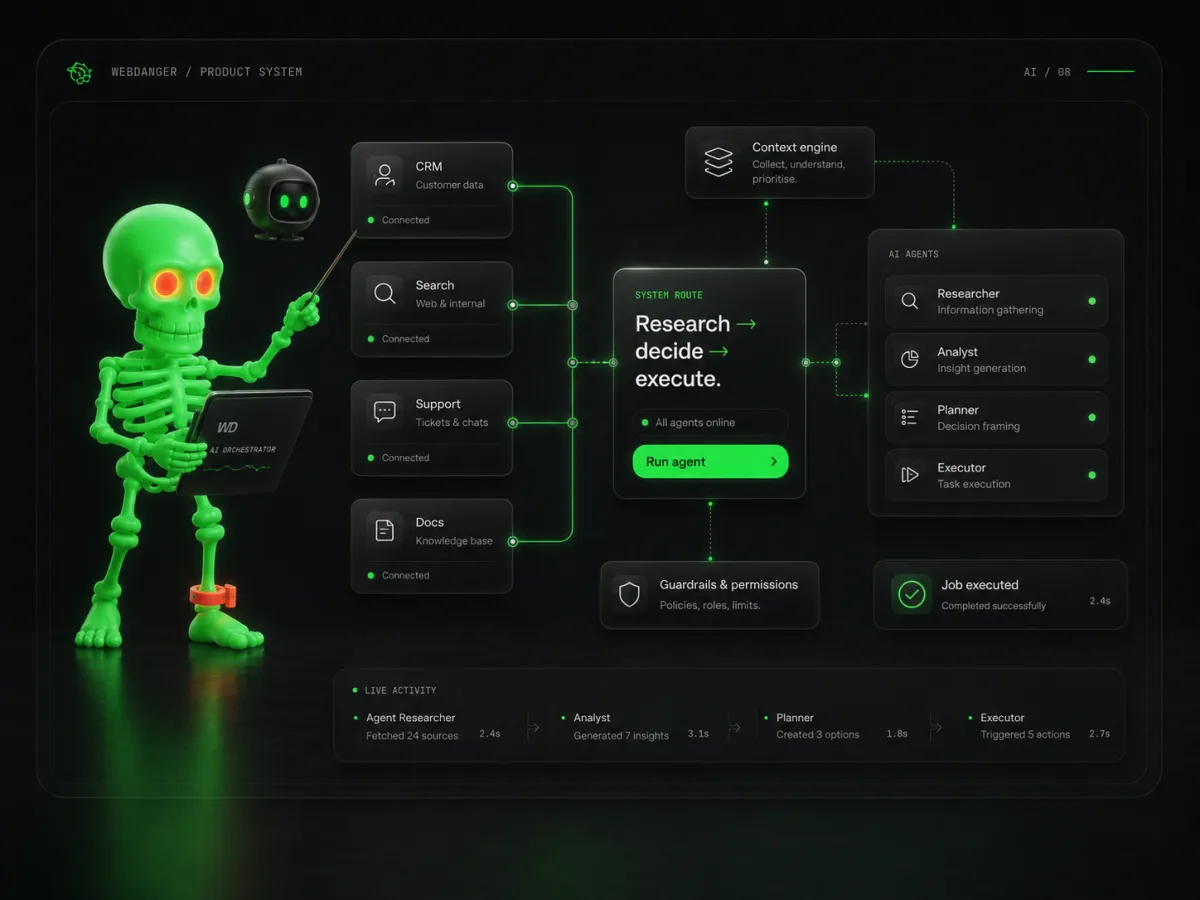
Useful AI needs context, guardrails, observability and a reason to exist inside the product. We design the job first, then decide which model deserves it.
Retrieval, source context and permissions reduce the gap between a confident answer and a useful one.
Tool use, approvals and validation define what the model may do—not just what it can imagine doing.
Latency, success rate and cost per task are tracked so the feature can be tuned like software, not defended like magic.
We pick a task with observable quality and decide what a good result means before writing prompts.
Real examples, edge cases, retrieval and tool behaviour are tested while the feature is still cheap to change.
Usage, errors, latency, cost and human escalation are visible from day one.
We like models. We like measurable outcomes slightly more.
Whichever best fits quality, latency, privacy and cost for the task. The architecture should not collapse because a leaderboard changed.
Yes, with an explicit data and permission model. We do not treat “connected to the knowledge base” as a security design.
Tell us what is stuck, expensive, slow or strategically important. We will turn the rough version into a concrete delivery path—with scope, ownership and the next decision visible.
hello@webdanger.com