Clearer product model
Navigation and hierarchy reflect what users need to understand, not the internal org chart.
Product design for interfaces with real states, real constraints and real people trying to finish a task. We prototype behaviour early so engineering does not receive a gallery of beautiful unanswered questions.
Build what's next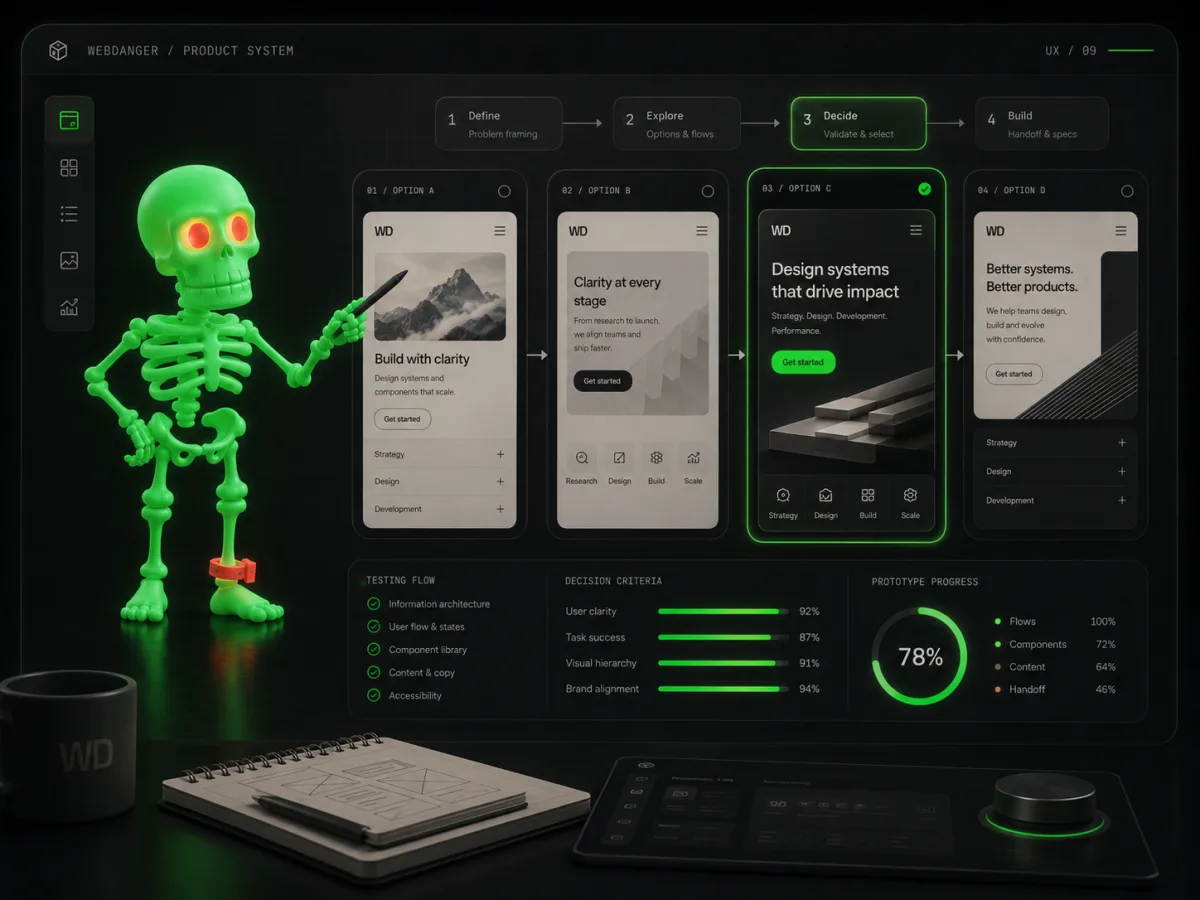
We use design to reduce uncertainty: information architecture, interaction, states, content and system rules are resolved before pixels become expensive code.
Navigation and hierarchy reflect what users need to understand, not the internal org chart.
Critical flows include loading, empty, error and edge states—not just the screenshot that makes the deck look good.
Components, tokens and patterns create speed without turning every future feature into a copy-paste archaeology project.
Jobs, constraints and success conditions are made explicit so the design has something concrete to optimise.
We test hierarchy and flows using realistic content before investing in visual detail.
Components and states are documented with engineering context so implementation does not require interpretation theatre.
We care a lot about polish. We just prefer polishing the right thing.
Yes. Ideally design and engineering overlap early enough to remove impossible ideas before they become cherished.
Yes. We can repair workflows, information architecture and component consistency while protecting the parts users already understand.
Tell us what is stuck, expensive, slow or strategically important. We will turn the rough version into a concrete delivery path—with scope, ownership and the next decision visible.
hello@webdanger.com